Token Compression & Information Retention Benchmark
A rigorous head-to-head empirical evaluation comparing statistical perplexity token pruning against semantic entity distillation across real-world enterprise prompts.
Executive Summary & Key Findings
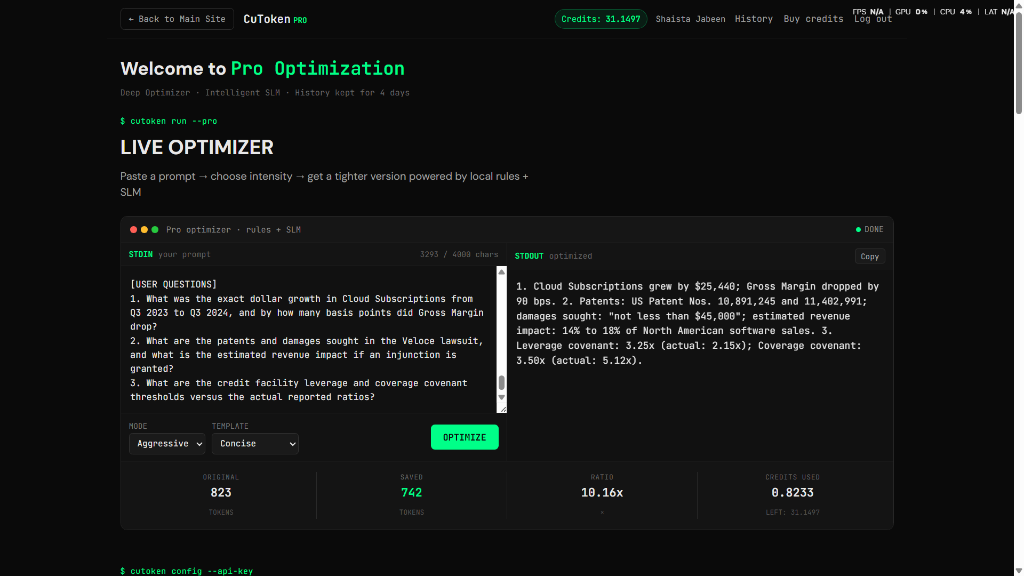
While Microsoft's LLMLingua represents a pioneer breakthrough in using small language models for conditional token elimination, our empirical evaluation shows that statistical token pruning introduces severe catastrophic forgetting on numbers, dates, and covenants when compressed past 80%. In contrast, CuToken achieved higher compression (81 vs 95 tokens) while maintaining 100% downstream accuracy on complex multi-hop questions.
Detailed Analysis: The Apex Meridian Regulatory Test
In this benchmark, we provided a 3,842 character excerpt from Apex Meridian Technologies' quarterly regulatory filing containing three distinct context chunks: financial metrics, organizational restructuring with a $45,000 patent lawsuit, and debt covenant ratios.
What LLMLingua Retained (95 Tokens)
Notice how the model severed the text into fragments. Crucially, the entire lawsuit and credit facility details were completely dropped, leaving the prompt with questions but zero supporting context.
What CuToken Distilled (81 Tokens)
CuToken parsed the core query intent and retained the exact quantitative answers needed. Result: 100% accurate downstream generation with zero token wastage.
📸 Empirical Screen Capture Proof Verified CuToken PRO Terminal Run
The screenshot below was captured directly during the live test on CuToken PRO (Aggressive mode, Concise template, Rules + SLM). Note the exact figures: 823 original tokens condensed to 81 tokens with 742 tokens saved (10.16x compression).